By: Nicholas Black
The “Valdosta National 2021”, is an event held by the Dedo Maranville Fine Arts Gallery at Valdosta State University, and many artists from all over the United States are represented at the “Valdosta National.” In an interesting turn of events due to the Coronavirus Outbreak, the “Valdosta National” is shown online for the first time in the show’s history. There is now a possible international audience to the show due to the better visibility of the show. Everyone with internet access across the world can view the “Valdosta National” at any time at their leisure. In some ways, however, there is a disadvantage to the “Valdosta National” being solely online. People cannot get a closer look at the art, especially with the three-dimensional artworks like the sculptures. There is a variety of artwork in 2021’s “Valdosta National,” as paintings, videos, sculptures, mixed media, photography, textiles, lithographs, and etchings are included. Cash awards were given to the top four winners at this exhibition and Claire Dempster was the juror and judge of 2021’s exhibition.
When one glances at the winners of the 2021 “Valdosta National” exhibition, each winner gave an interview about why they created their art. This also provided background information about their art, which was interesting to witness. But, for all of the artists who were not given awards, there was a lack of interviews by these artists at the exhibition. The winner of the exhibition was Samuel Dunson’s mixed media Self Portrait. This was one of the more noticeable pieces at the “Valdosta National” due to the piece’s colorfulness and zany nature. It is a representational piece from the artist, but with several twists, such as the eyes of the face being on the forehead. The man within the painting wears a mask, and is inside a chaotic environment. The subject within the painting appears to be the artist himself, expressing his emotions about the impact of the Coronavirus Pandemic, which makes this painting representational.

Mixed Media on canvas, 72″ x 48″ x 2.5″, 2020
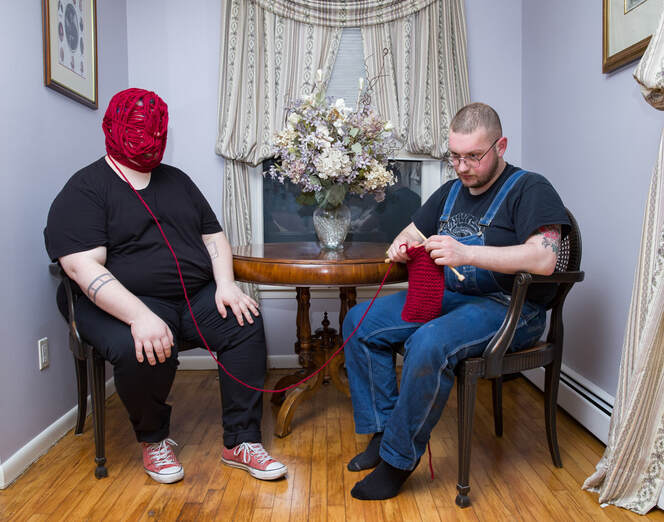
The second place winner was the print Untitled, from “Disidentifications” series by Jesse Egner. Egner’s artwork was an inkjet print, which featured two separate figures sitting in a room. One figure is wearing a knitted red mask, while the other figure is in the process of constructing the mask. Untitled appeared to be quite unusual at first glance, but this caused the photograph to be quite eye-catching. Untitled seems to deal with masking oneself while one is in pain. Egner’s piece dealt with issues of his past relationships in the LGBT community along with the idea of disidentifications.
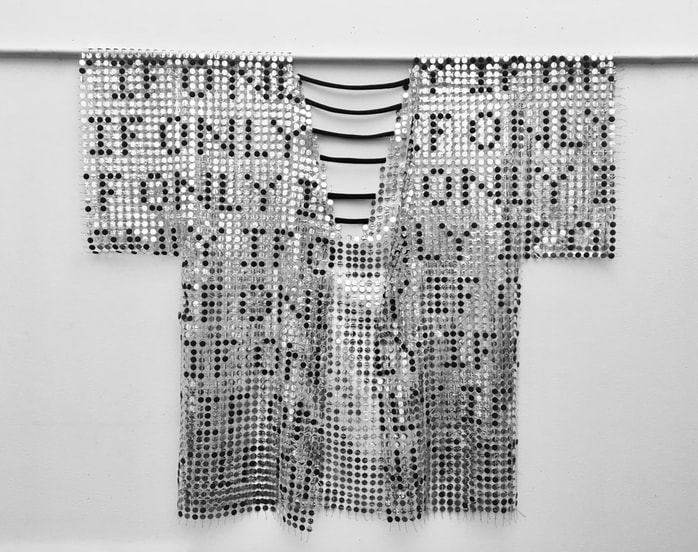
Third place was Alex McClay’s fabric piece If Only. McClay’s piece was about boundaries and barriers that surround the bodies of women. If Only is made from an emergency blanket, but it looks more like a normal shirt, with the statement “If Only” repeated as a pattern on the shirt. An emergency blanket was used because it is a survivor’s tool, reflecting past experiences of sexual assault and robbery McClay experienced while on a road trip.
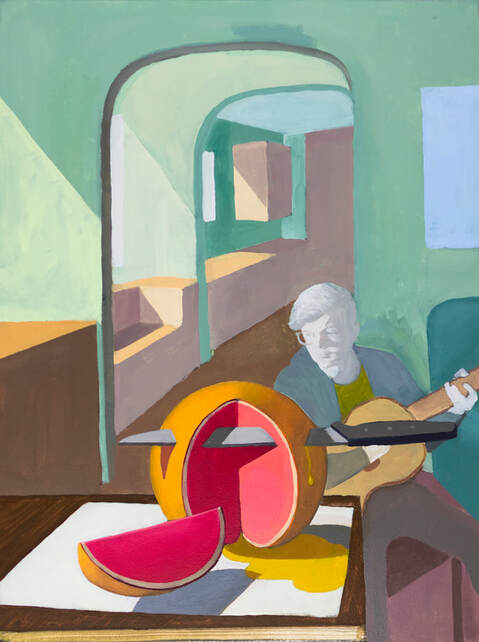
Fourth place was Joseph Kameen’s oil painting Not Going Backwards, which according to the artist’s statement, was about Kameen’s experiences with memories about his life. It has a dreamy, yet hollow, atmosphere with flat looking colors. A cut melon appears in the foreground, while a man holding a guitar in the background. This painting definitely looks like something drawn from the memory of the artist.
Some of the artworks have a noticeable political tone or message. M Blevins’ mixed media piece Poor People’s Campaign 1969 comes to mind. This artwork looks like the American flag, with red, white, and blue seen. The blue area looks like the sky, with a moon and stars. There are droplets in the red area, which possibly represent tears. A mule is seen, tied down to the rocket, as if being forced to stay on Earth while the rocket is free to visit space. A protest sign is seen, with slogans that criticize the United States government for spending too much money on the Space Program, while there were many children who lived in poverty. With this information, Blevins’ piece is an obvious, direct reference to the real Poor People’s Campaign that was organized in the late 1960s. The original event critiqued and protested the federal government’s decision to give large amounts of money to the NASA Space Program instead of using the money for the nation’s poor. This criticism could be used in modern times in a similar manner. For example, Blevins’ message could be used to critique the failures of various state governments and the federal government to assist vulnerable populations in the coronavirus pandemic.
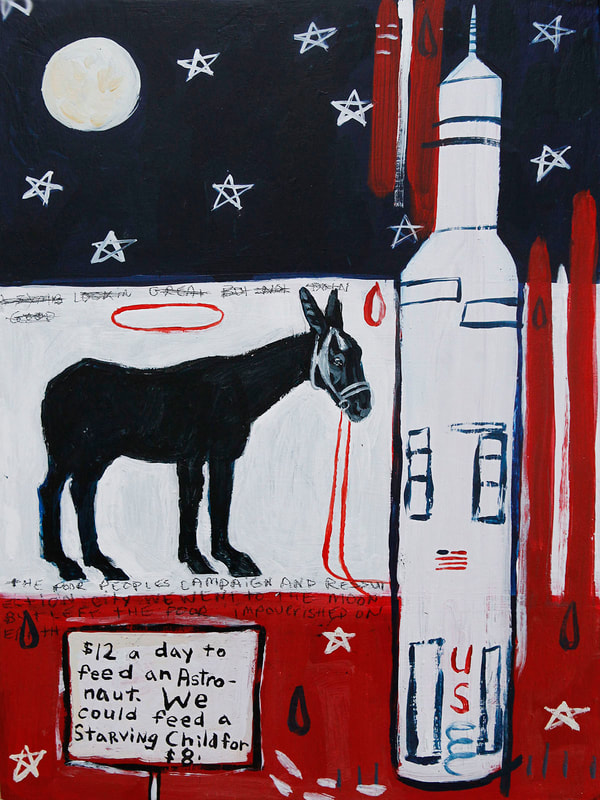
Mixed Media on Wood, 15″ x 11.25″ x 1″
The exhibition at “Valdosta National” offers a glance into the minds of artists across the nation. There was a wide variety of works here, from oil paintings to videos to sculptures from dozens of different artists. The transition to an online platform was smooth and easy to navigate. If only there were more statements from the artists who were not winners of the exhibition, then viewers could understand more about the intentions of the artists. But overall, the “Valdosta National” was successful in bringing attention to many artists, and this online only exhibition works very well in that aspect. The “Valdosta National” has to potential to give more recognition of the Dedo Maranville Fine Arts Gallery at Valdosta State University since anybody can visit the website.
Nicholas Black is a senior minoring in art at Valdosta State University.