by Joseph Mays
As I entered the exhibit, titled “Mixed Bag: An Assortment of Contemporary Craft,” I quickly noticed the vast amount of open area. Each artwork had enough space to allow the viewer to walk around and look at it from multiple angles. Each artist whose work was displayed had spent time with each other during their residency at Arrowmont School of Arts and Crafts in Gatlinburg, Tennessee from June 2017 to May 2018. In fact, this bringing together of their work was like a reunion for them, seeing as though they all moved to separate states upon the end of their residency. I’m sure being in each other’s presence had some sort of influence on the art they made at the time, and here, we see a unifying theme of usually sensitive topics and themes.
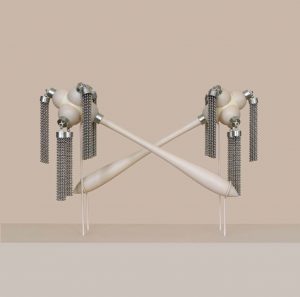
Emily Culver likes to create objects that are open for interpretation to viewers. She focuses on tools, highlighting the relationship between tools and the human body and how they act as extensions of the body and its capabilities. Culver says that she enjoys creating artwork that subverts expectation, meaning it can exist in more than one way. By doing this, one can look at it differently than usual and make interpretations based on your own personal experiences. One of Culver’s works, Flails shows two tools known as flails. Immediately I noticed how the tools are made mostly of wood, which differentiates from the usual all metal finish. It also provides a vintage feel Depending on one’s knowledge of flails, they can look at these objects and try to figure out the use value that these tools may have. Traditionally, flails were used as an agriculture tool that would loosen and separate grains from their husks. Next was another piece by Culver titled Portal. It looks as if someone attempted to create their own portal use commonly-found materials. The use of copper gives a slight futuristic feel, while the piece as a whole is on the minimalistic side.
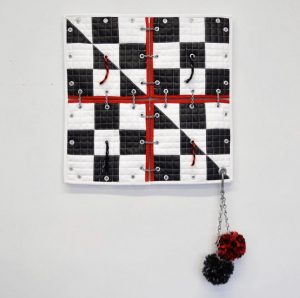
Next, was the work of Max Adrian. The goals of his work are to push viewers to consider their own personality and shape alternative identities. His piece, titled Queer Quilt with Asymmetrical Accessory, is rather intriguing. Quilts have a history of storytelling and comfort; however, this does not look like the traditional quilt. There are four smaller squares connected with chains and two furry pom poms hanging off the side. The irony of taking something that represents comfort, such as a quilt, and giving it a more exotic look, allows for Adrian’s piece to become an activator for “imagined relationships.” This is fitting because the word “queer” means unusual or strange. There are similar qualities in another one of his works, Scrap Alphabet, where Adrian takes a plethora of cut and scrap material and places individual scraps in clear pouches. Chains connect the pouches and the piece as a whole resembles a grid. This work, in a way, resembles a large jewelry holder, where the individual pouches are used to hold earrings and other small jewelry. In regards to the title, some of the scraps actually resembled letters of the alphabet, while most were more abstract.
M. Paige Ward’s series, How Firm A Foundation, consists of geometric wooden figures sitting atop blocks of concrete. The concrete resembles pillows which are enhanced by the creases, folds, and cracks that give off the effect of pressure caused by the wood. The bigger the piece of wood, the more the concrete appeared to be deformed by its pressure. M. Paige Ward says she looks to “utilize domestic and architectural symbols and materials to explore [her] longing for permanent security and comfort.” This was achieved because the way the wooden figures sit comfortably on the concrete without any leaning provides a sense of comfort and peace.
Joseph Mays is a Bachelor of Art Student at Valdosta State University. With a focus in graphic design, Joseph’s passion for art and design has grown over the years and plans to graduate and pursue a career in the art field.