Rasheem Callender
When visiting the Valdosta National over at www.vsugallery.org, viewers are met with information regarding this show’s conception. The Valdosta National is an annual competition and it is hosted by Valdosta State’s Dedo-Maranville Fine Arts Gallery. The competition is open to all artists over eighteen living in the US and the goal is to present the best of the best entered in the competition. The work presented is all media contemporary art made in the last five years. Due to the global pandemic, this year’s show was held at the gallery’s online space instead of the physical space that students and staff are used to. This year the show was juried and judged by Claire Dempster, and she selected a total of 70 works by 60 artists out of the total of 875 works that were submitted.
Dempster is an Atlanta-based writer and arts administrator. In Dempster’s juror and judge’s statement, she speaks about her careful selection of works by saying, “For the Valdosta National 2021—virtual by necessity—I sought to capture the intimacy of a physical show while acknowledging the unique circumstances of a digital space and the particularly bizarre specifics of 2020.” This statement is especially true for the winners of the prizes in the show. I plan on going in depth about the top three winning pieces.
First place was awarded to Samuel Dunson for his Self Portrait. This piece is a large, multi-colored, expressive painting and its one to behold. The artist rendered himself in a way that is surreal, painting the subject from the shoulders up wearing a mask, and their eyes are painted without any pupils. The subject’s hand touches their face, but alongside their hand you see a green ghostly hand not touching their face which echoes the familiar sentiments “wash your hands and don’t touch your face” that people globally got so used to hearing over the summer. There are many pieces of this work that are a reminder of the sickness that plagues our society. Dunson’s painting is a wonderful display of the sudden changes that occurred in our society due to our health crisis. Dunson says in his artist statement, “My work has become a coping mechanism which allows me to express my feelings and emotions within artistic means. Though my aim is to tell my own personal story, my work tends to be universal in its comprehension.” (Dunson, 2021) Which helped me know that he is aware of the multiple interpretations his work may convey. This piece could be considered an expressive portrait.
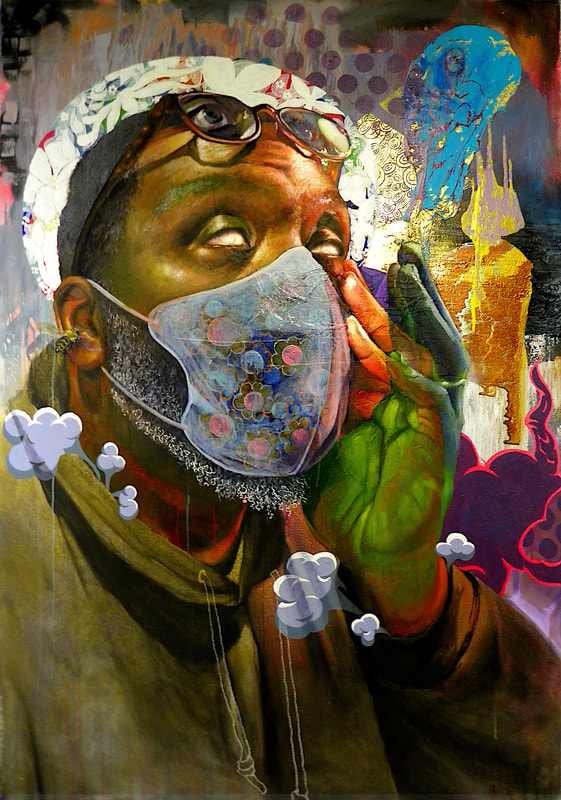
The work contains elements from graffiti also. Gray graffiti clouds are shown around the face of the figure. I interpret these clouds to represent coughing. It is probably one of the many self-portraits that have been painted in this time with a mask on. Small details cover the painting like a burning candle and a bumble bee, and faces make their own individual appearances within the painting. The viewer is led to believe that these all have an intimate significance to the artist.
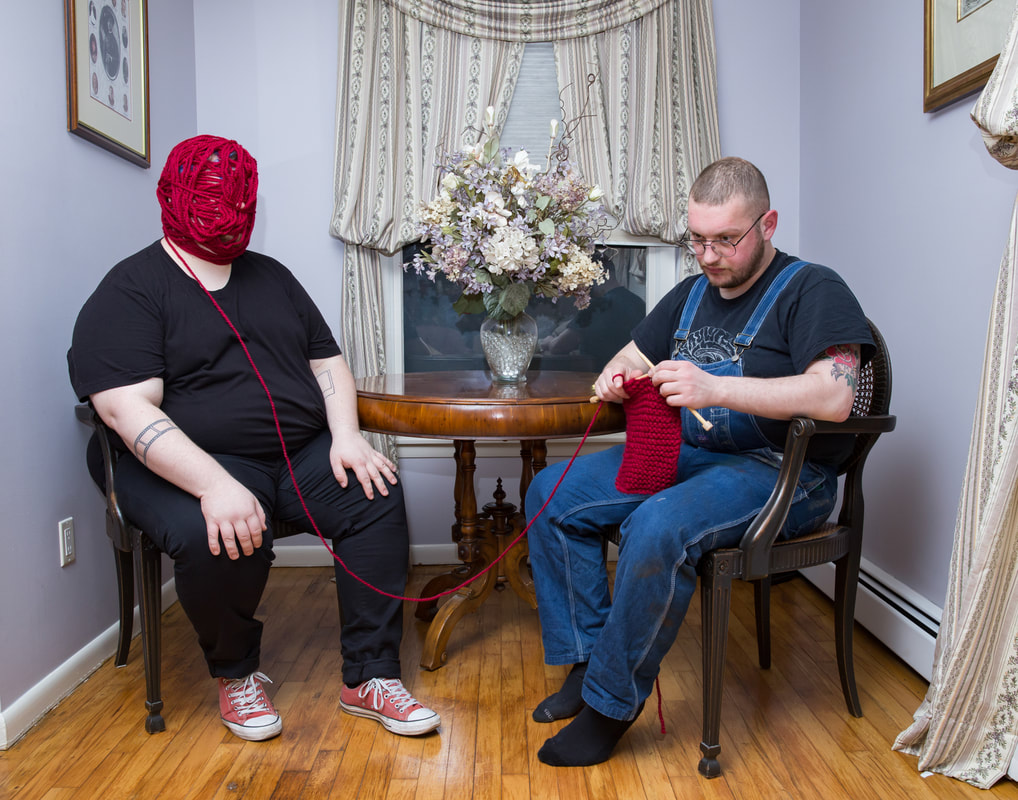
Scrolling down to the second-place winner, the photograph is titled Disidentifications by Jesse Egner. Viewers are confronted with a full color image of two individuals sitting opposite of each other in front of a table set with a bouquet of flowers. One person has a face that is a ball of yarn and a knitted object is being crafted by the hands of the other person. A long piece of yarn connects the ball to the object the other person is sewing. This piece of yarn is connected to the other person’s hands and this thing they are knitting. It looks like a scarf. This photograph is balanced as it has a use of bilateral symmetry because the people are sitting facing each other sitting in similar positions. The artist explains this piece as, “Absurd, unusual, and playful portraits of queer individuals meant to evoke the uncanny, humor, and curiosity.” (Egner, 2021) The piece eerily reminds me of The Two Fridas by Frida Kahlo. Kahlo created the work to represent loneliness and anguish after her divorce from her husband and I would not be surprised if the artist conveyed a similar mood intentionally.
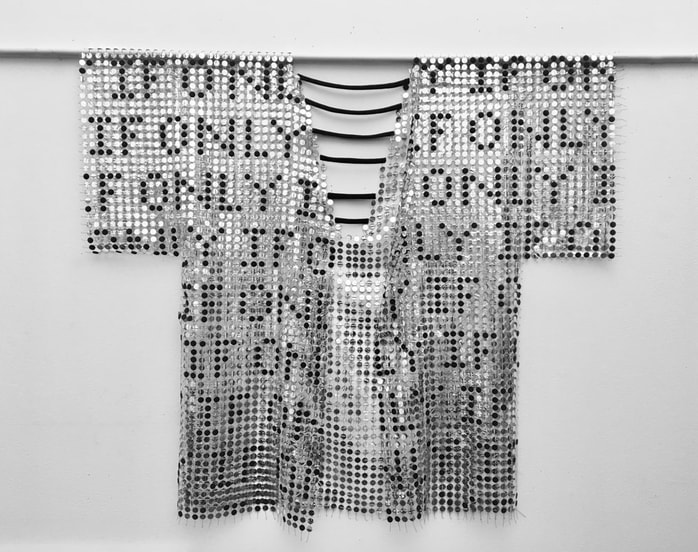
The third-place winner is a sculptural piece by Alex McClay, and its entitled If Only. The piece is a garment that looks like a cardigan. The piece is made from an emergency blanket, fabric, and thread. The sculptural piece is hung from a pipe and the phrase “If Only” is repeated on it. The piece is intriguing, because it’s so vague in meaning. About the use of the blanket, McClay states, “The materials I use in these acts of making communicate specific messages. For example, language and text are the most useful and fundamental ways that we can communicate our needs to one another. I imagine a string of words coming out of your mouth and finding their way to the ears of whoever is listening. Or, a text: constructed and deconstructed on a pixelated grid, sent through the airwaves from one screen to another. I use emergency blankets for both their symbolic and reflective purposes. A friend once described them as “the coldest warm you could feel”, referring to their use as a blanket in emergency situations. Ultimately, I think about this material as representing a means to an end, a tool in a survivor’s kit, a protective layer, a way to communicate and signal for help, a symbol of survival. I also use survey flags and survey tape, a material used to mark and measure land. According to American Public Works Association, pink marking material specifically signifies a measuring, or a surveying, of the land (other colors, like blue and yellow, signify water and gas, respectively). This material is used to set invisible boundaries where they otherwise wouldn’t exist.” (McClay, 2021) The artist seeks to convey an idea of boundaries between people and how they are constructed and broken down on a regular basis. The use of the safety blanket was meant to speak about how boundaries make a system of abuse very visible, and what we should do to fight it.
While one can certainly miss being able to see these works in person, the website certainly was able to capture the essence of the competition’s art lovers are used to seeing. The judge was very deliberate in her selection of works even the works that did not win top three are remarkable. All the works this year are great and I even see a few familiar faces from Valdosta nationals of the past. Let us hope that next year we can see these works on the walls as well as on an online presence to give viewers options. Seeing the works in person would allow viewers to have a newfound appreciation of the artwork because one can view the work in the way of the artists intent.